
Spring has Sprung Early in the Rockies
It’s time to start thinking about spring and gearing up for the seasonal transition on our local watersheds. The weather has been unusually warm as of late, and the river is beginning to wake up much earlier than normal. With these warm weather trends, anglers can expect reliable midge hatches and should come to the river prepared to imitate the various stages of their development—larvae, pupae, and adults.
Spring fishing brings an interesting twist to matching the hatch because this is when the “gorilla midge,” or large spring midge, begins to emerge. These larger midges can complicate things when it comes to choosing the appropriate fly and the correct size. Many anglers are accustomed to fishing tiny midges throughout the winter, but the presence of these bigger bugs means trout often key in on a slightly larger meal. The walk away here is that you don’t always have to fish with miniscule offerings when imitating midges!
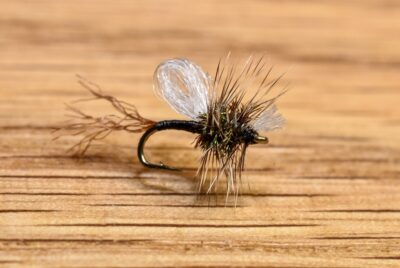
Pat’s Midge is deadly during the spring when trout key on the gorillla midge. My go-to sizes are an 18-20 in March and a size 20-24 during the remainder of the year.
The best advice that I can give you is to make sure you carry a wide range of sizes in your midge selection. When fish are feeding on the larger variety, it’s important to upsize your pupae and adult patterns accordingly. Some of my favorite pupae for this time of year include size 18 Medallion Midges and Beadhead Black Beauties. One of my favorite patterns for imitating the adult spring midge is my new signature pattern with Umpqua, Pat’s Midge, which fishes exceptionally well in a size 18 this time of year.
That said, don’t overlook the smaller midges. They remain an important food source, and trout often key in on them at times just as selectively as they do during the winter months. Successful anglers must take the time to observe what’s happening on the water and determine which size and stage of the midge the fish are concentrating their efforts on. Making the right fly changes can make all the difference in the outcome of your day.
As we move toward the latter part of March, savvy anglers understand the importance of adjusting their fly-strategy throughout the day. Early mornings are still prime time for midges, but by mid-day the focus often shifts to Baetis, better known as Blue-Winged Olives. Baetis nymphs begin to move around mid-day, and trout frequently key in on them heavily between 1 and 3 p.m. Once the hatch fizzles out in the late afternoon, fish typically return to feeding on midges sporadically for the remainder of the day.
When it comes to Baetis nymphs, two of my go-to patterns are a size 22 Mercury Baetis (tied on a 2x long hook) and a size 20 Top Secret Baetis. If fish start rising to the surface, I’m a big fan of fishing Craig Mathews’ Sparkle Dun to imitate the emerging duns. I typically reach for sizes 18 or 20 to match the newly hatched duns. If the fish are keying on emergers or cripples, Craven’s Mole Fly is a great option.
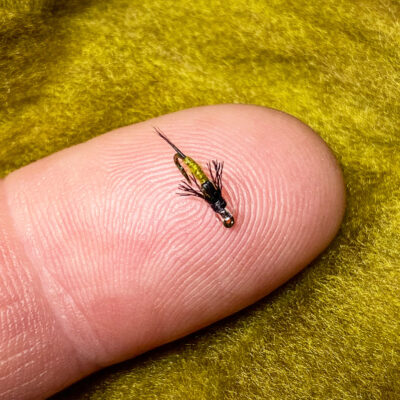
The Mercury Baetis (pictured) and Top Secret Baetis are two of my favorite Baetis nymphs. I like up-size my Baetis nymphs in the spring because they are larger than those found in the autumn.
With the unusually light snowpack this year, I expect Blue-Winged Olive hatches to extend well into May with the lower flows. Conditions like this can set the stage for some outstanding spring dry fly fishing.
I’m also anticipating some excellent caddis hatches as the season progresses—but we’ll save that conversation for another blog. I’d reecommend getting out now while the getting is good. We’ll keep you up-to-date as things progress with this unprecedented drought.